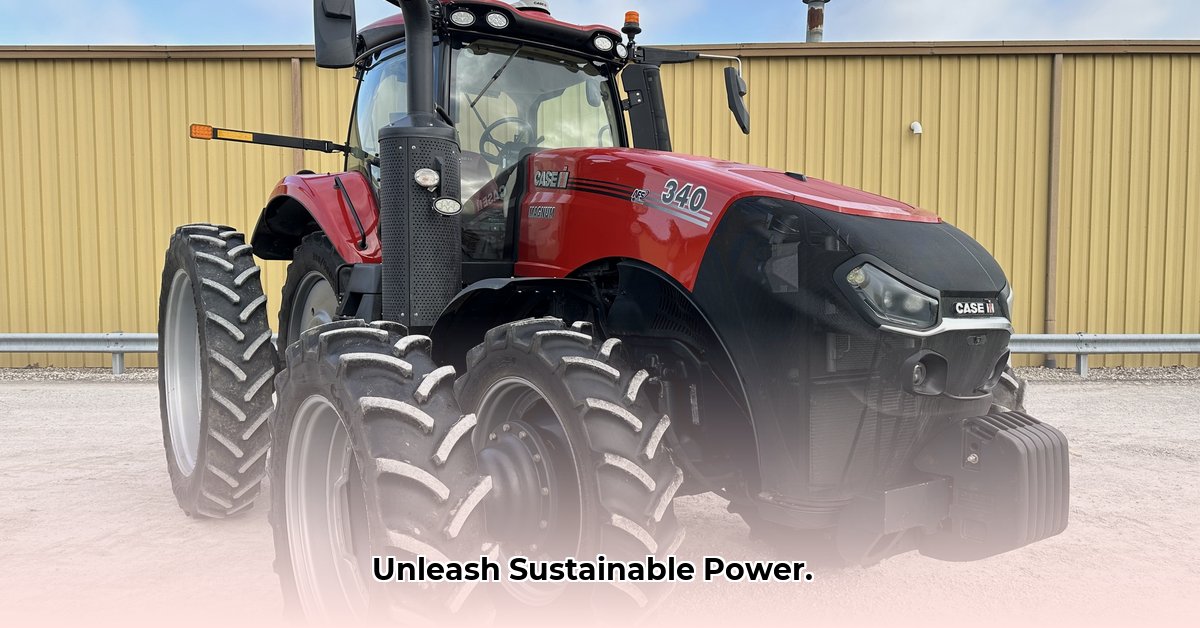
The Case IH Magnum 340 tractor represents a significant advancement in high-horsepower agricultural machinery, offering farmers a powerful and technologically advanced solution for modern farming practices. This detailed technical review examines its capabilities, compares it to competitors, and assesses its role in sustainable agriculture. Understanding its strengths and weaknesses is crucial for informed decision-making by farmers and agricultural businesses. For more tractor reviews, check out this helpful resource.
Power and Performance: A Detailed Look
The Magnum 340 boasts a maximum horsepower rating of 375 hp and a PTO horsepower of 290 hp, figures that place it firmly within the high-horsepower tractor segment. This substantial power output translates to increased efficiency in large-scale farming operations. The availability of both standard wheel and innovative Rowtrac™ systems offers adaptability to diverse field conditions and farming practices. The Rowtrac system, in particular, minimizes soil compaction, contributing to long-term soil health and reduced environmental impact. But how does this translate into real-world fuel efficiency? Further data is needed to fully quantify this advantage. Does the increased power offset the potential fuel consumption? This is a critical question for cost analysis.
The Price of Power: Total Cost of Ownership (TCO) Analysis
The initial investment in a Case IH Magnum 340 is considerable. However, assessing the true cost requires a comprehensive total cost of ownership (TCO) analysis, comparing it with similar models from John Deere and New Holland. Such an analysis must account for fuel consumption, routine maintenance, repair costs, and ultimately, the tractor's resale value. Only by considering all these factors can farmers accurately evaluate the long-term return on investment.
Smart Farming Integration: Precision Agriculture Capabilities
Modern farming necessitates seamless integration with precision agriculture technologies. While Case IH highlights the advanced hydraulics of the Magnum 340, precise details regarding its compatibility with GPS guidance systems, variable rate application technologies, and other precision farming tools are needed. A thorough assessment of user-friendliness and integration capabilities is crucial for optimizing workflows and minimizing resource waste. How easily does this tractor integrate with existing precision agriculture setups? A simplified workflow is key to efficiency.
Sustainability Assessment: Environmental Impact and Lifecycle Considerations
Sustainability is paramount in modern agriculture. A comprehensive evaluation of the Magnum 340's environmental footprint is essential. This includes a detailed examination of fuel efficiency, greenhouse gas emissions, and its potential role in soil erosion prevention. The Rowtrac™ system's contribution to reduced soil compaction and improved fuel economy requires further quantification. Moreover, the analysis must extend to the tractor's end-of-life management and recyclability, encompassing the entire lifecycle from manufacturing to disposal.
Competitive Analysis: Market Position and Long-Term Viability
The Case IH Magnum 340 operates within a competitive landscape. Success depends not only on raw power but also on factors like cost-effectiveness, reliability, and technological adaptability. A thorough market analysis, comparing it to key competitors like the John Deere 8335R and New Holland T8 series, is vital. This analysis should incorporate both short-term and long-term perspectives, considering factors like maintenance costs, operational efficiency, and overall return on investment. Which model offers the best balance of power, efficiency, and long-term value?
Risk Assessment Matrix: Identifying and Mitigating Potential Challenges
A comprehensive risk assessment is crucial for informed decision-making. The following matrix outlines potential risks associated with the Magnum 340:
| Risk Factor | Likelihood | Impact | Mitigation Strategy |
|---|---|---|---|
| High Initial Investment Cost | High | High | Secure financing options; explore leasing programs. |
| Maintenance Costs | Medium | Medium | Establish preventative maintenance schedule; extended warranty consideration. |
| Technological Obsolescence | Medium | Medium | Opt for models with adaptable technology; continuous monitoring of upgrades. |
| Fuel Price Volatility | Medium | Medium | Focus on fuel-efficient operation; exploration of alternative fuels. |
| Soil Degradation | Low (with Rowtrac™) | Medium | Implement best soil management practices; utilize the Rowtrac™ system effectively. |
Regulatory Compliance: Environmental and Safety Standards
Adherence to evolving environmental regulations is paramount for the Magnum 340's long-term success. Compliance requires proactive monitoring of regulatory changes and adapting to evolving standards. This encompasses emissions control, fuel efficiency mandates, and waste management regulations. An understanding of ongoing compliance efforts and costs is crucial for both manufacturers and end-users.
Key Takeaways:
- The Case IH Magnum 340 offers significant power and potential efficiency gains for large-scale farming operations.
- A thorough TCO analysis, comparing it to competitors, is essential before purchase.
- Seamless integration with precision agriculture technologies is crucial for maximizing efficiency.
- The tractor’s long-term viability depends on its sustainability performance and adherence to regulatory standards.
- A comprehensive risk assessment and mitigation strategies should be put in place before investment.
Further research and detailed data are required to fully quantify the advantages and disadvantages of the Case IH Magnum 340, especially regarding fuel efficiency, total cost of ownership, precision agriculture integration, and overall sustainability performance.